This is the second piece that I wrote for our local news bulletin. I’ve added a few extra photos and slightly embellished the text. I hope you enjoy …
Dear Reader
I spent over one year diligently learning Spanish on Duolingo for my trip away. I had two weeks with my family, and I wanted to be able to read basic signage and have a simple chat with the people I met. Of our two grandchildren, the youngest, Master 2 (soon to be 3), understood English but rarely spoke it. The elder, Master 4, was a confident duo linguist: English, and not Spanish, but Catalan. I’m not going to cover the separatist relationship between the Catalan province of Spain and the rest of the country, but needless to say, it is a very real thing. Everywhere I visited, from small villages to larger towns, the pride of being a Catalan citizen was evident. Catalan flags were displayed from many windows, and Spanish was not spoken in shops, supermarkets, schools, or cafés. (Even though Spanish is the official language and a compulsory school curriculum subject from around 10 years of age.) My grandchildren did not speak or learn Spanish in their ‘school’ and did not speak it at home. Our son, who is almost fluent in Catalan, does not speak or understand Spanish. So much for that brilliant idea of mine, it was completely and utterly redundant!
Our family live in a small village of 200 registered inhabitants. Of those 200, many are casual residents; only around 80 people live there permanently. The village is about an hour’s drive North-West of Barcelona (87km), set off the main road on a hilly outcrop. The streets have been recently resealed to remove the uneven cobblestones and provide a smooth surface – great for kids on bikes and wheelie things! The buildings are mostly two or three stories tall, side by side, with thick earthen walls and doors that open right onto the calle, or street. The church has had worshippers since the 1020 somethings. History is very evident in every step you take and every breath you take.
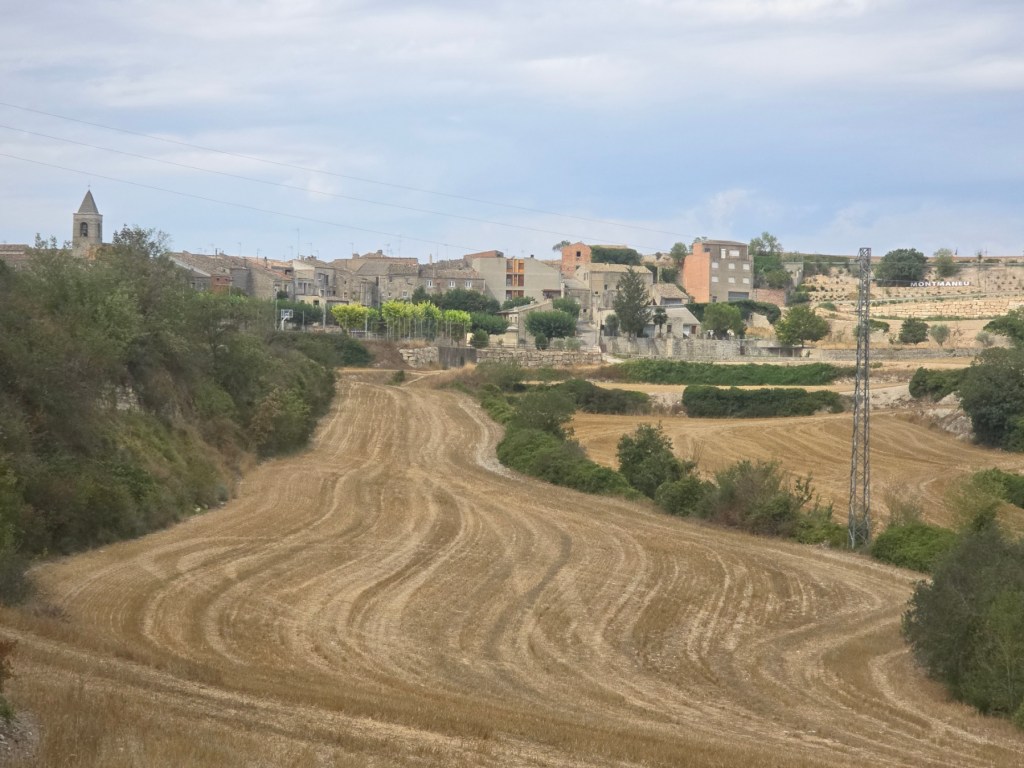
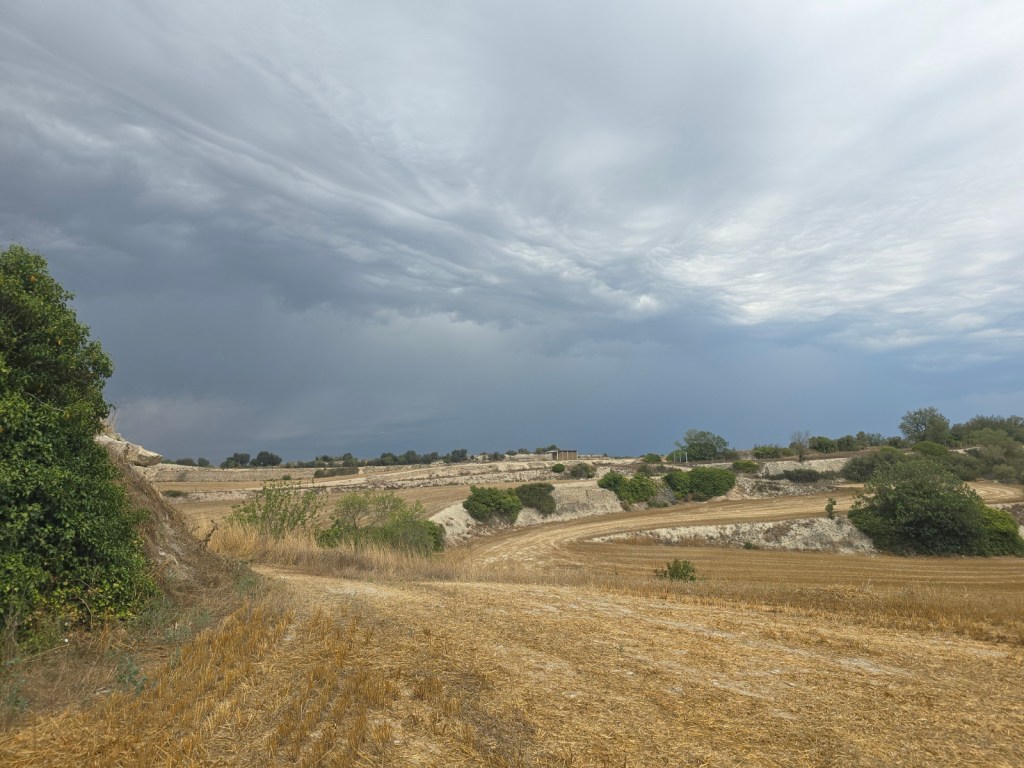
Oh, the air! In the area of The Village and almost everywhere I travelled in the Catalan region, there are farms, but no animals to be seen. All the stock, cattle, pigs, goats, sheep, chickens, and horses are kept inside in purposefully built barns. The paddocks had very dry stubble when I was there, due to grain and canola harvests. For a rural Kiwi, this was an odd phenomenon, and I found myself constantly looking for livestock when we were out and about. I did see some horses and a few young cattle, but that was all.
Two paddocks down from the hill that The Village was set on was a pig farm. As soon as I arrived the odour of pigs was in my nostrils! It stayed my entire visit, sometimes a lot stronger than others. The hot, dry, sticky days with very little breeze were the worst! At times it was very intense but the locals didn’t seem to be bothered. It was never mentioned, not even by the children, I guess they were accustomed to it.
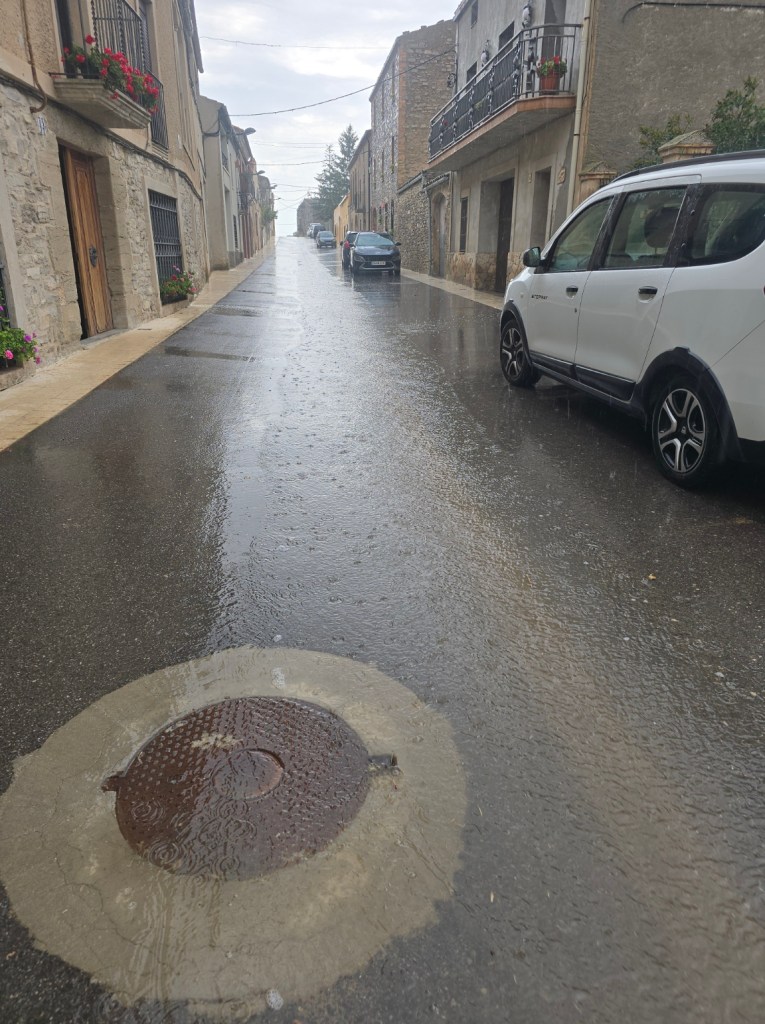
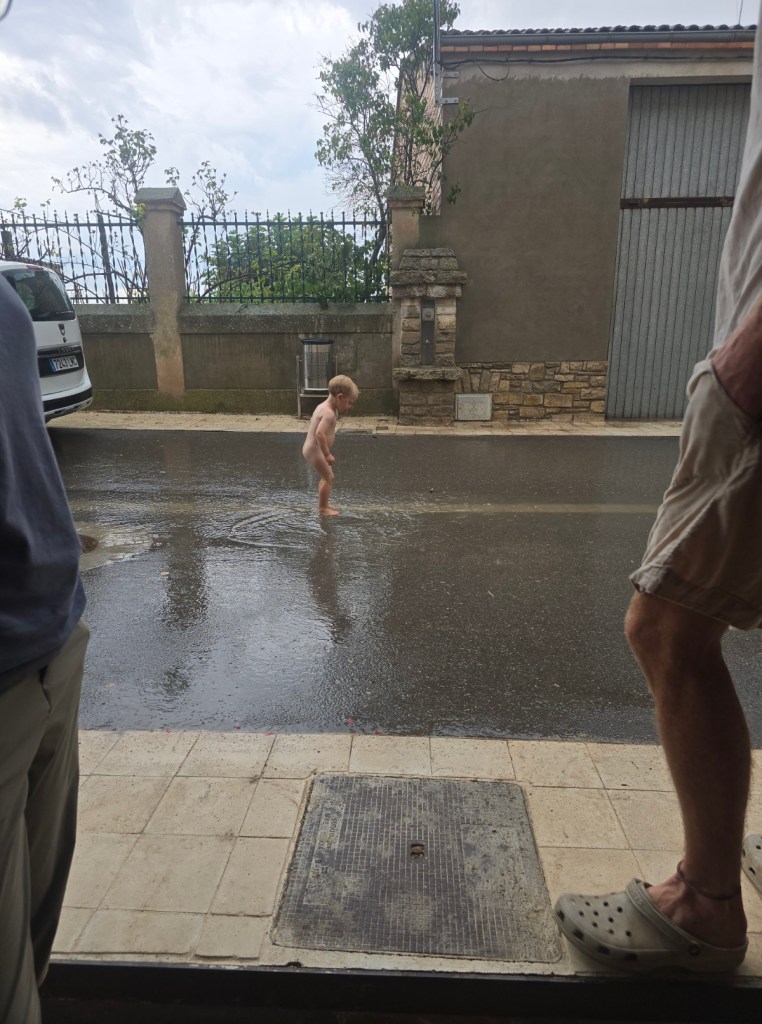
The day that my sister and I arrived it rained. There had not been any rain for a very long time and the land was parched. The calle, or street, very quickly filled with water and had a small rivulet running down its centre. People opened their front doors and stood in the shelter of the buildings and enjoyed the water as it poured off rooves and down the street. Master 2 was super excited! He very quickly shed all his clothes and proceeded to jump in puddles and play with abandonment. The fact that this wonderful event, (the rain), was credited to us, the foreigners from the Southern Hemisphere, gave us a wonderful entry into The Village, its people, and its life.

To be continued …
Yours Sincerely,
A Sexagenarian on her First European OE
 Wild4eva